The Restless Line: Notes on the First Log and the Last Carving
Text by Jesse Wine
While, in many readings, the figure of the artist is seen as someone who brings order to chaos, Rafael Triboli suggests that there is also chaos within sense itself, taking as his material the world as it is, along with chance and its unfolding possibilities. In a quiet and honorable way, Triboli maintains a willingness to engage with matter, to be surprised by its natural condition, to question it without diminishing it, and to draw out its qualities through transformation. His works therefore exist on a threshold—held by ambiguity—between full force and the smallest gesture, between acceptance and tempest. Triboli’s curiosity about the vastness of the world and its many possible processes comes together with a kind of serendipity—an attentive and thoughtful way of working that welcomes the unexpected, finds complex dialogues through simplicity, and is grounded in a generous openness to listening.
In his studio, this way of thinking becomes clearly visible, as if the workspace itself reflected the space of his thought. Pieces at different stages of making gather together; drawings sit alongside objects still undecided; cloth-bound books are covered by a fine layer of sawdust that spreads across the working surfaces. Nothing feels entirely settled. There is always something in progress, something being returned to, something that persists. The work does not stop: when it is not carried out by hand, it continues as an ongoing mental activity.
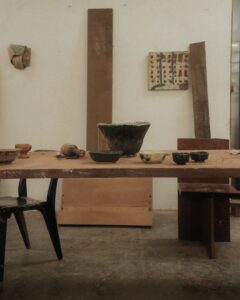
This constant process of experimentation shapes Triboli’s practice, from his early works in plywood and carnauba wax to more recent pieces made with mahogany, ebony, bronze and clay. Several works are developed at the same time, as if the creative energy comes from the coexistence of different pieces in the studio, each one influencing the others in an extended and restless process. Forms and ideas persist, return, find resolution, or remain open. This repeated way of working is driven by continuous development, avoiding the stability of a single medium. For Triboli, experimentation is not about seeking novelty for its own sake, but about cleverly finding, each time, new ways of listening to the material, new possibilities for dialogue, and new approaches to creative questions under changing conditions. This approach is also guided by a sensitivity to the time held within matter: his works deliberately retain traces of contact, wear and process, bringing layers of memory into the foreground as part of their material presence.
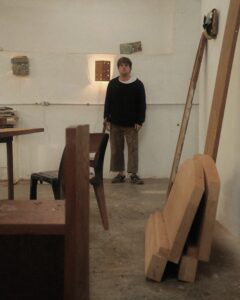 Photos above by Victoria Yamagata
Although there is a clear coherence of thought and a recognisable visual language throughout his practice, Triboli’s work is rooted in difference—in the unique and unrepeatable meeting between gesture and matter. In this context, exact repetition, which is central to serial design, becomes less meaningful when faced with the singularity of each work. From this perspective, it is possible to rethink a long-standing idea within Eurocentric art history that strictly separates the roles of artist and designer—a distinction that many practices have already blurred. Triboli’s drawings, ceramics and furniture, while attentive to the specific qualities of each material, share a common gestural approach and a structural understanding, and can be seen as variations within the same field of work.
Slide to see more of Triboli´s work ➝





Photos above by Fernando Mendes
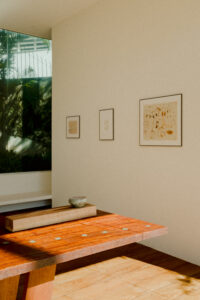
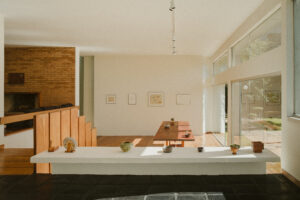
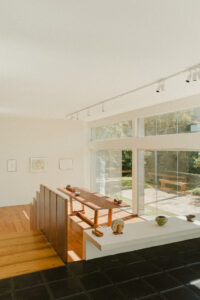
The large mahogany table produced for this exhibition presents a top composed of a robust plank that slowly opens: at one extremity, an expressive gap expands from a fissure that begins as fine as a hairline at the centre of the plane. The artist does not conceal or correct this opening; instead, he stabilises it with small wooden butterfly joints that hold the structure in place while preserving the split as a structural decision. What would conventionally be understood as an imperfection within monolithic and orthodox traditions of sculpture and joinery here introduces a negative space that coexists with an irreducibly robust material. As in ikebana, this negative space operates as a structuring principle for the other works arranged upon the table, organising the intervals between elements and establishing a theatrical field of resonance in which emptiness intensifies the presence of forms in a scenographic manner. This table-stage is further traversed by a sinuous line that may recall the silhouette of a mountainous landscape, punctuated by square bronze elements with a bluish patina, cast by the artist from wax and subsequently embedded into the wood.
In the fireplace surround, composed through the architrave-like juxtaposition of three pine slats, Triboli reiterates the importance of the minimal gesture and an approach to essentiality akin to assembling timbers into a hut. The history of the material itself is foregrounded over any ornamental display of technical virtuosity. Only at the cornice does he subtly accentuate the knots of the wood, as if they were minor calls—magnetic stars guiding the insertion of small bronze elements. The energy emanating from the material, at once physical and spiritual, is amplified by its situation: the wood structuring the fireplace, within arm’s reach, may itself be consumed by fire, converted into heat and light. The frame, traditionally associated with painting, is here displaced into the field of sculpture, emphasising the bronze element as if delimiting a stage.
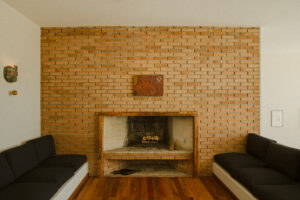
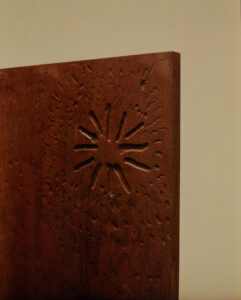
This scenographic field becomes more defined with the introduction of a plane that, by association, recalls the role of curtains in a theatrical space. Triboli presents a work whose wooden surface is marked by carved and painted interventions that radiate from central forms, suggesting the energy of celestial bodies—solar or stellar—as if lightly casting particles of light across the scene. The logs that would normally rest at the centre of the fireplace for burning are displaced and reappear to the side in the form of three wooden cones—pine knots gathered with great delicacy, as if quietly whispering to each other. This closeness gathers a certain energy, one that emerges through proximity and careful attention to the gesture that arranges them, as though the grouping itself creates its own intensity. In this way, the stage is no longer contained within the fireplace alone, but is activated by Triboli across the entire exhibition space. There is a spatial choreography in which distances and proximities are intentional, and the space between the works is also understood as a sculptural matter.
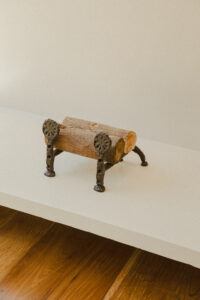
A few steps ahead of the fireplace, Triboli presents two identical sculptures cast in bronze: small three-legged chimeras whose circular tops bear the frontal gaze of a lion, with grooves radiating like a mane. Initially conceived to support pieces of wood within the fireplace, they are displaced, yet continue to hold the same material: a log rests upon them, embedded by the artist with small blocks of patinated bronze. It is precisely the decision to inlay this metal and to present the log on a base that shifts its meaning—no longer a material to be burned, but something placed within a different symbolic and semantic field, as if a minimal gesture could determine the very purpose of the material.
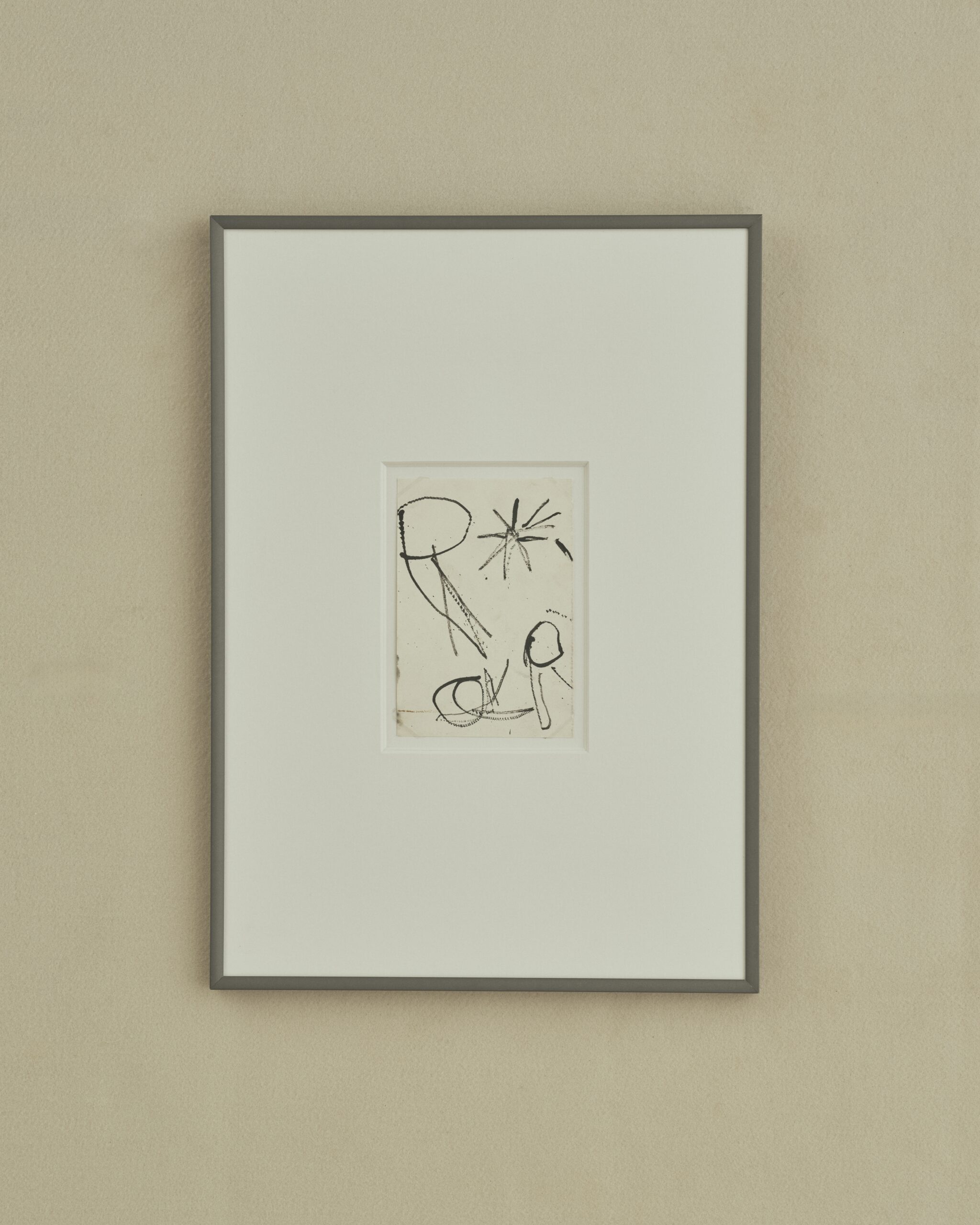
In his drawings, Triboli mobilises gesture as a direct inscription of thought, avoiding both virtuosity and excessive hesitation. They emerge as records of a consciousness in act—recalling the classical image of the hand as the immediate extension of the mind—held in constant tension between impulse and control. They are structured through a rhythmic, almost respiratory variation, in which each modulation recalibrates the total compositional field. What surfaces is a language reduced to essential terms, where scale, weight, and the relation between intervals come forcefully into play.
At times, the line becomes attenuated, grazing disappearance; elsewhere, gesture is traversed by an acute awareness of its own material precariousness. From this economy emerges a minimal radicality: circles still vibrating with the trace of movement, calligraphic inflections as fragments of an unknown alphabet, multi-pointed stars, spreading stains. Such restraint displaces gesture from the domain of expression into that of language. Letters, signs, and graphic marks appear as unstable units—neither fully legible nor entirely abstract—establishing a zone of indeterminacy in which seeing and reading become simultaneous operations. Treating paper as an operator of an active atmosphere, Triboli refuses the given figure, instead investing in possible constellations sustained by a tension between dispersion and connection.
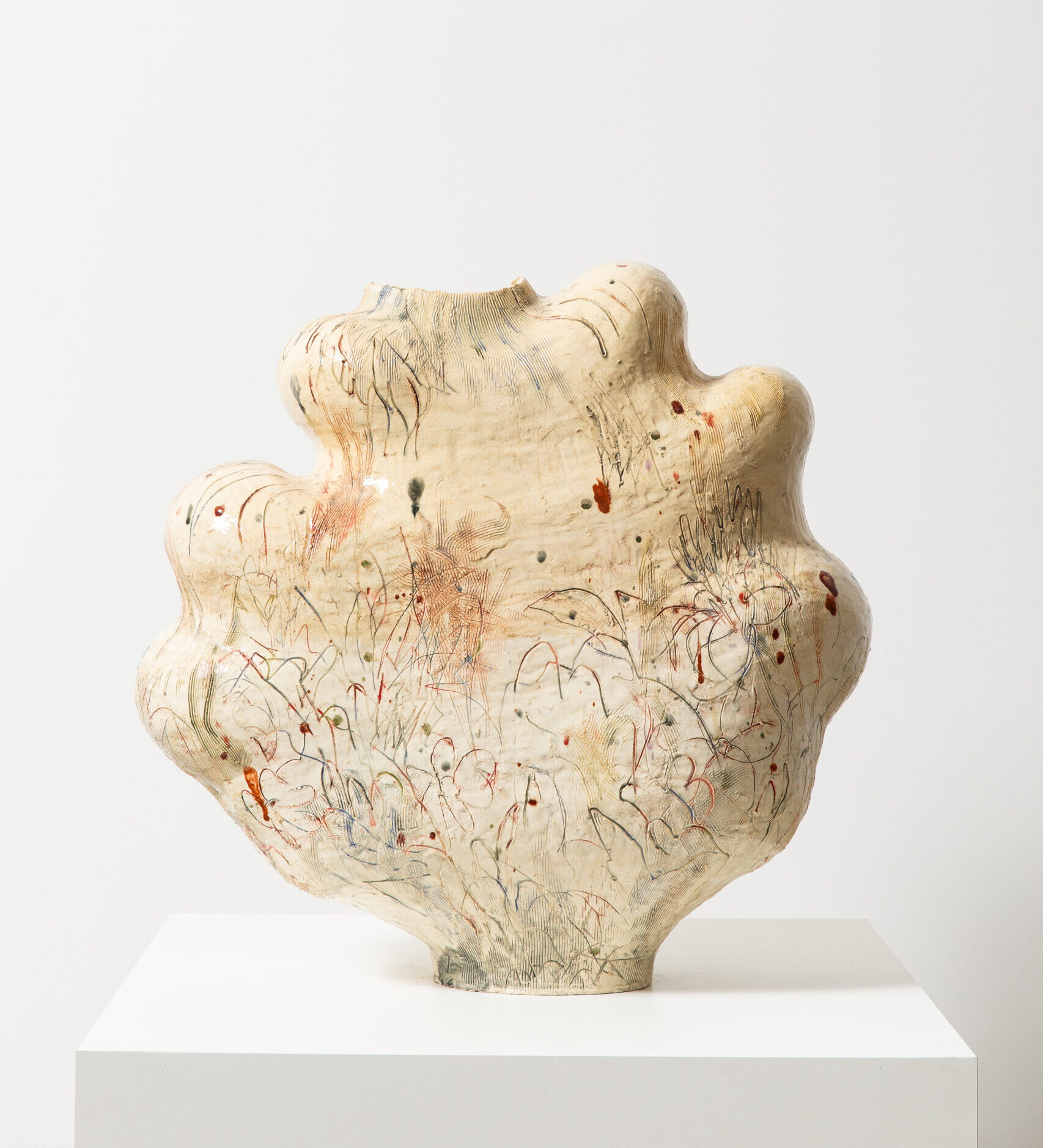
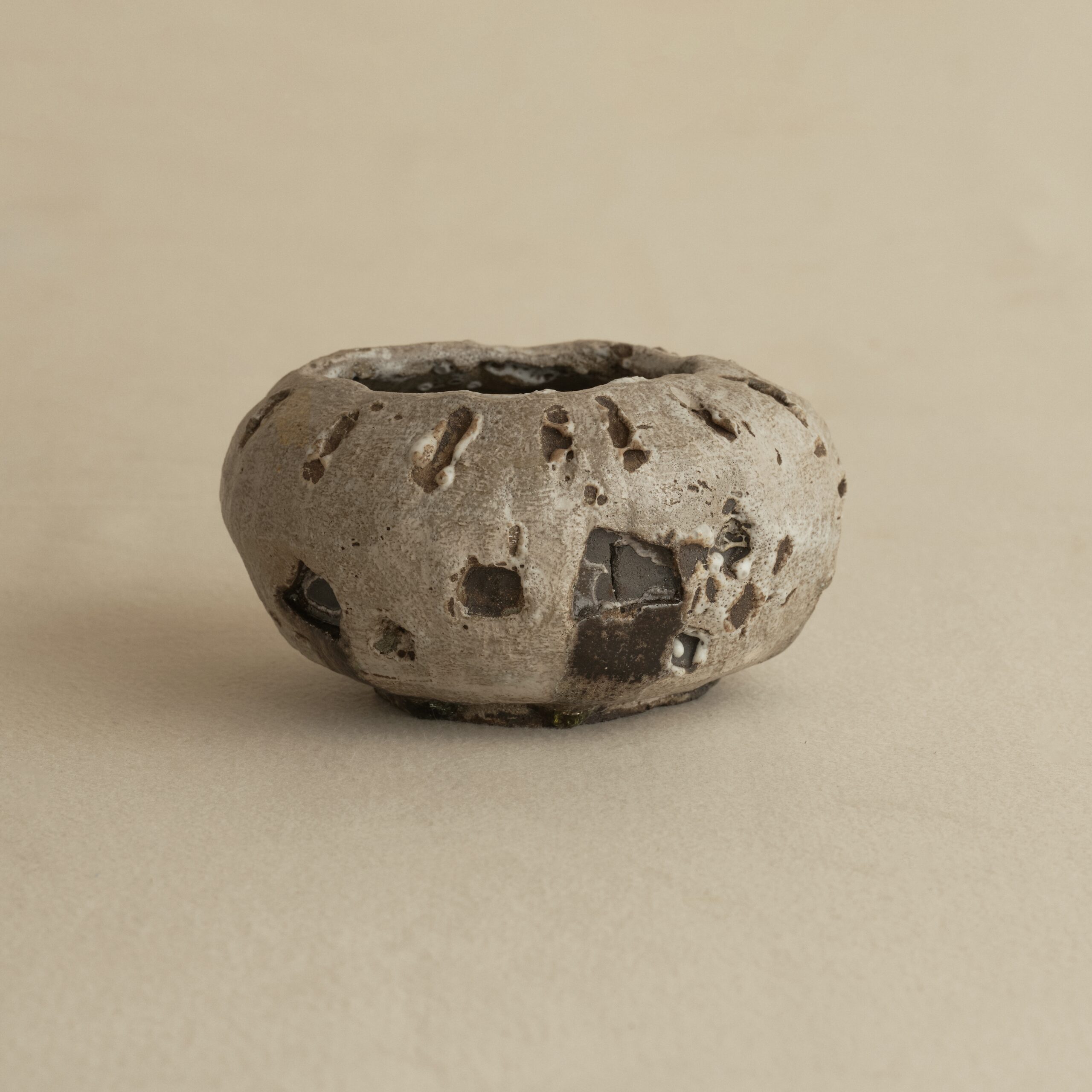
In his ceramic production, while Triboli reveres millennial traditions—particularly those centred on the wheel—he equally engages in a form of disobedience guided by experimentation. Although clay may appear as the plastic material par excellence, it is no coincidence that it functions as a metaphor for the formation of the human in Christianity (as in Genesis 2:7). Etymologically, Adam derives from adamah—the Hebrew term for “earth” or “soil”—indicating that the name of the first human bears within it the mark of its material origin, as that which is literally formed from the ground. The human thus emerges not as a separate entity, but as a conscious fold of terrestrial matter, such that to know the world entails recognising oneself as an ontological continuity of that which one treads upon, manipulates, and inevitably returns to.
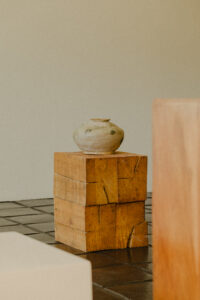
This understanding amalgamates the historical relations between human and clay: like those produced millennia ago, Triboli’s ceramics carry investigations that manifest through ever-inaugural gestures, connecting to a mineral, cosmic temporality. He recognises in clay an irreducible agency: during the sculptural process, the material asserts a certain form, often dictated by its own mass. What unfolds is a material negotiation—a listening to what the material wants, or might come to want—rather than the imposition of formal will upon a fully pliable substance. To this are added the unpredictabilities of glazes, patinas, and oxides developed through successive experiments, yielding singular qualities constituted through processes that remain, to a large extent, untraceable in each piece.
Although Triboli demonstrates a profound admiration for Shaker furniture—produced by the eighteenth- and nineteenth-century North American religious community whose work, marked by formal austerity, constructive precision, and reverential intentionality, exerted a lasting influence on modern design—as well as for monastic labour and a certain cryptic mode of writing, his conception does not organise itself as a religious programme. What emerges instead is an abstraction of liturgical symbols and the elaboration of a space of celestial inflection, traversed by a cosmic aspiration: stars and rays articulate a mental field of ritual contemplation without anchoring themselves in any specific devotional matrix.
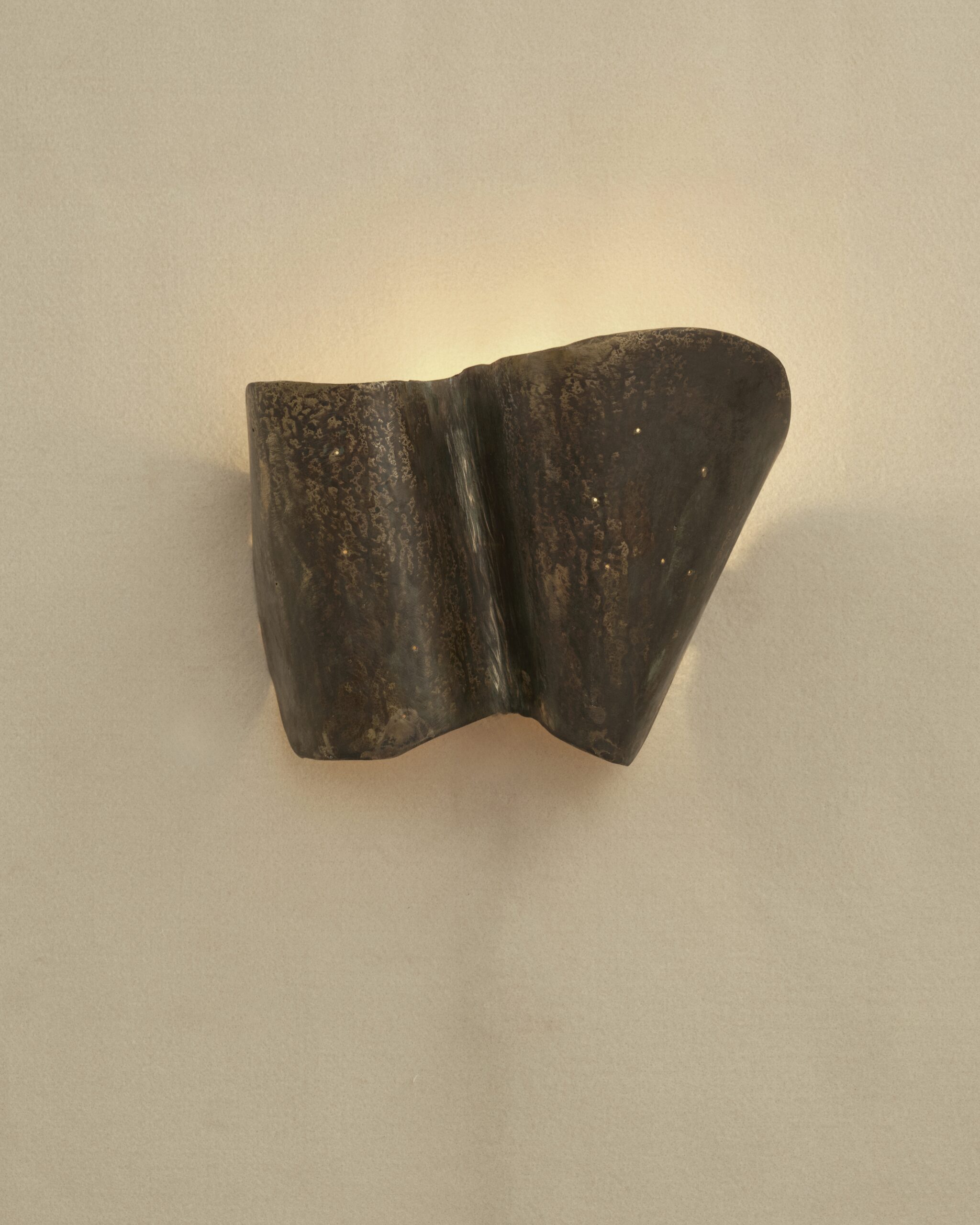
It is perhaps here that the restless line traversing his practice reveals its most precise function: as a metaphorical operator capable of connecting, in constellation, radically distant temporal orders—from primordial matter to the instant in which gesture suspends itself and refuses to advance upon material, establishing a minimal difference between the first log and the last carving. This same principle runs through his furniture, ceramics, and drawings, articulating scalar dynamics that begin at the measure of the body and, at times, dissipate towards the celestial; surfaces that accumulate distinct processes—from patination and perforation in bronze to glaze and engobe in ceramics, from carving to polishing in wood—as records of transformation; and masses that impose their own temporalities, from the slow growth of vegetal bodies to the geological cycles from which clay emerges. Triboli’s work unfolds within a field in which matter and gesture remain in permanent negotiation—unstable, irreducible—reflecting a worldview grounded in singularity and indeterminacy.
Photos above by Ana Pigoso
–
To see more of Rafael Triboli click here.